A simple five-step guide to dressing for your body type, from measuring your shape to checking the final fit
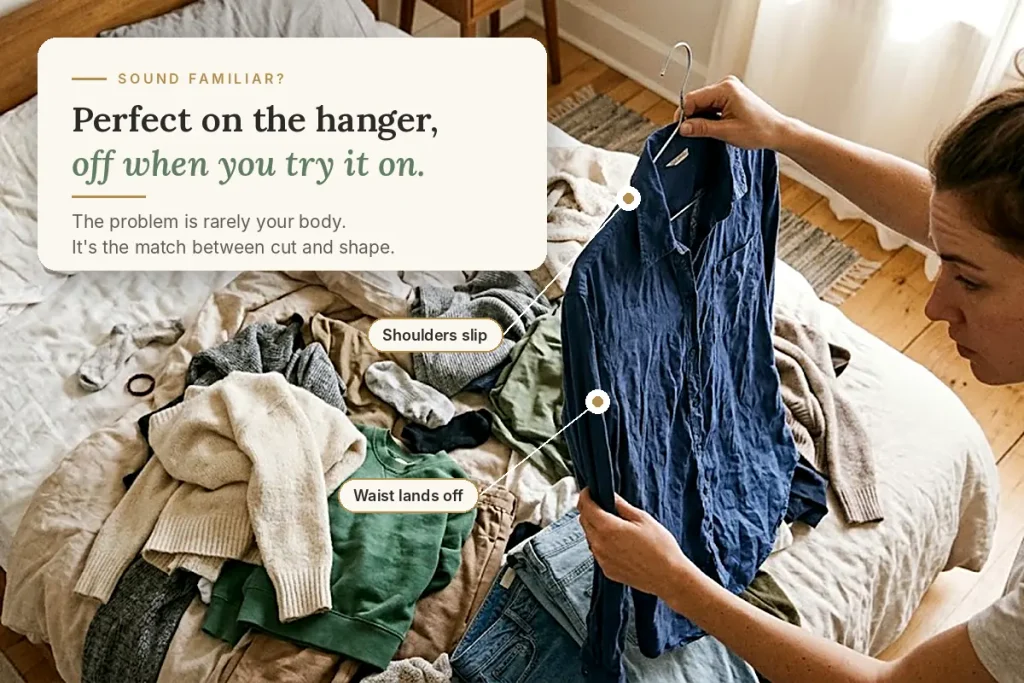
You know the moment. A shirt looks perfect on the hanger. Then you try it on and everything feels off. The shoulders slip. The waist lands in a strange spot. You leave the fitting room empty-handed and a little discouraged.
Here’s the good news: the problem is almost never your body. It’s the match between the cut and your shape. Learning how to choose clothes that fit your body type works like finding the right key for a lock. The correct key slides in without force. The wrong one jams no matter how hard you push. This guide gives you a five-step system for dressing for your body type. You’ll measure your shape, set a styling goal, pick the right cuts and fabrics, and check the final fit. Whether you shop online or in stores, you’ll find clear steps to try this week.
Quick answer: how to choose clothes that fit your body type in 5 steps
- Identify your body shape with four simple measurements
- Set a styling goal by deciding what to highlight or balance
- Pick cuts, necklines, and rises that support that goal
- Choose fabrics that drape or hold structure to match your shape
- Run the fit checklist and tailor anything that’s almost right
Why Dressing for Your Body Type Matters More Than Trends
Trends come and go like the weather. Your proportions stay with you. That’s why choosing clothes for your body type pays off far longer than chasing whatever’s popular this month. A well-fitted plain tee often looks sharper than an expensive jacket that hangs wrong. Fit changes how tall you look and where the eye lands. It even changes how you carry yourself. Clothes that fit let you stand straight and move freely. Clothes that fight you make you tug and adjust all day.
Money matters too. People who understand clothes that fit their body type return fewer items and own fewer “almost right” pieces. They shop with a plan instead of a hope. One distinction helps here: fit and flattering aren’t the same thing. A garment can match your measurements perfectly and still not suit your shape. Fit is about size and construction. Flattering is about cut, proportion, and fabric. Great outfits do both jobs.
The stylist Rachel Zoe put the bigger idea simply: “Style is a way to say who you are without having to speak.” Clothes that fit your body type let that message come through clearly.
Illustrative Case Study: Two Friends, One Dress
Imagine two friends who buy the same dress in the same size. The first has broad shoulders and a straight waist. The second has narrower shoulders and a defined waist. On the first friend the dress pulls across the upper back and falls like a tube. On the second it skims the waist and moves beautifully. Nothing is wrong with either person. The dress simply matches one shape better. That’s the whole idea behind a body shape clothing guide: the same item behaves differently on different bodies.
A quick reminder before we go further. Body types are guides and not rules. Style writers who focus on broad-shouldered women make the same point. No shape is the “right” one. What counts is wearing clothes that suit yours.
Step 1: Find Your Body Type Before You Shop
How to Measure Yourself for Clothes
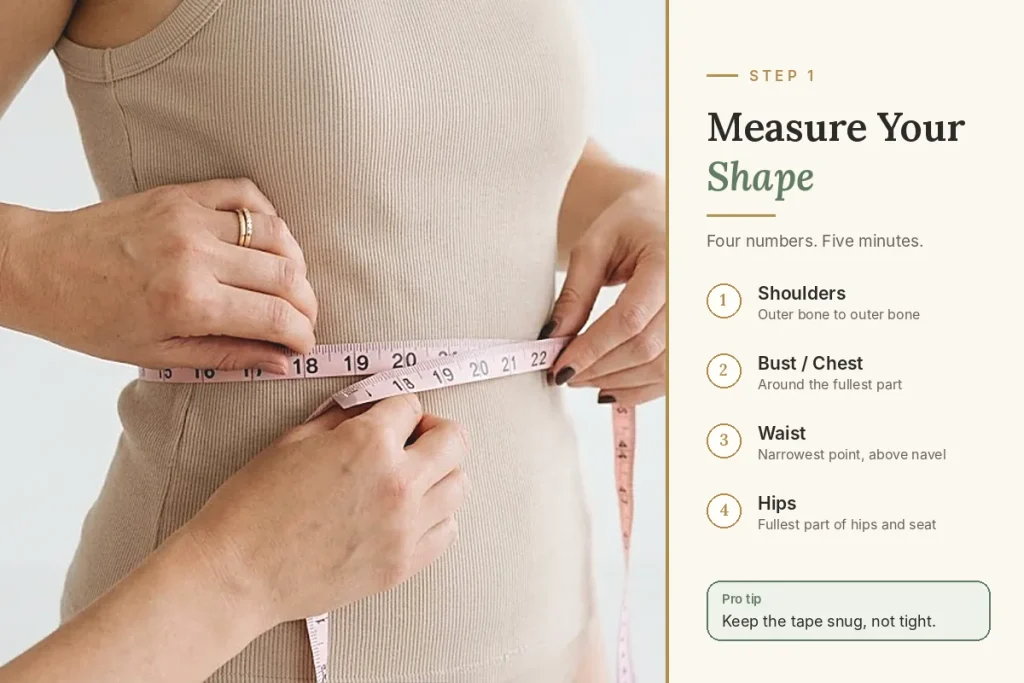
You can’t choose well until you know your starting point. Luckily this takes about five minutes. Grab a soft measuring tape and stand in front of a mirror. Wear thin clothing or measure bare. Keep the tape snug but not tight and level with the floor. Write each number down.
- Shoulders: Measure across the widest point from one outer shoulder bone to the other.
- Bust or chest: Wrap the tape around the fullest part.
- Waist: Measure at the narrowest point, usually just above the belly button.
- Hips: Measure around the fullest part of your hips and seat.
Now compare the numbers to each other. Scale weight tells you nothing about shape. What matters is how your shoulders, waist, and hips relate.
Common Body Shapes for Women
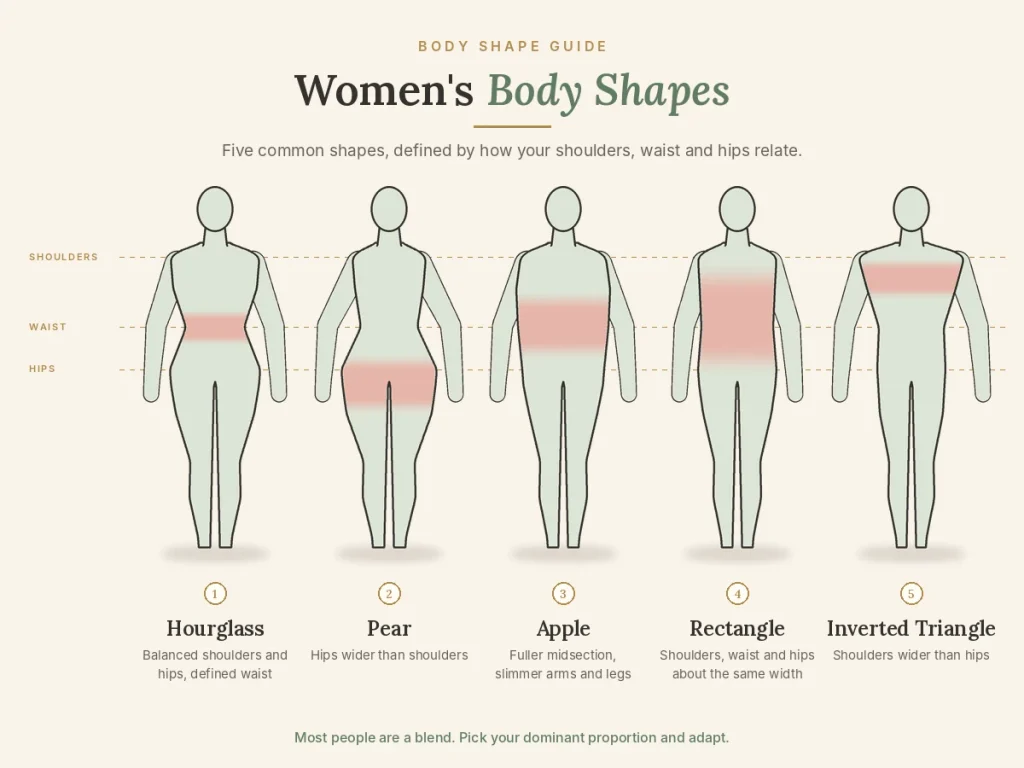
- Hourglass: Shoulders and hips are close in size with a clearly defined waist.
- Pear (triangle): Hips are wider than the shoulders.
- Apple (round): The midsection carries more volume while arms and legs are often slimmer.
- Rectangle: Shoulders, waist, and hips measure about the same.
- Inverted triangle: Shoulders are wider than the hips.
Common Body Shapes for Men
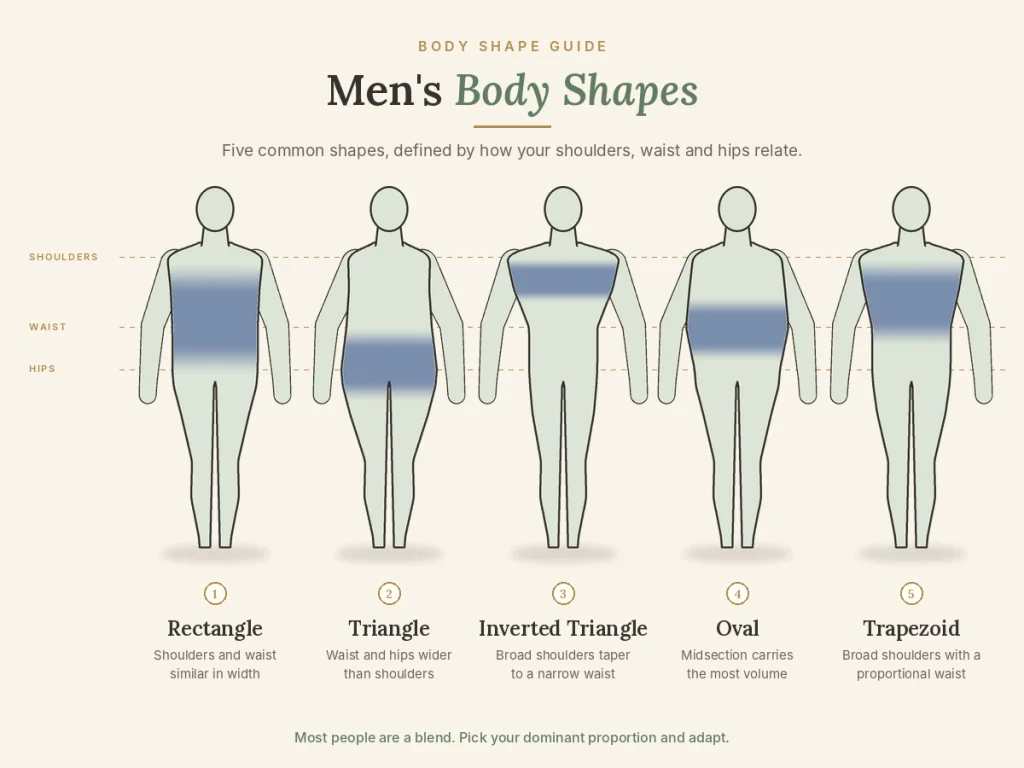
- Rectangle (straight): Shoulders and waist are similar in width.
- Triangle: The waist and hips are wider than the shoulders.
- Inverted triangle (V-shape): Broad shoulders taper to a narrower waist.
- Oval (round): The midsection carries the most volume.
- Trapezoid: Broad shoulders with a proportional, athletic waist.
What If You Don’t Fit Neatly Into One Shape?
Most people don’t. You might be part pear and part rectangle. That’s completely normal. Pick the shape that describes your dominant proportion and adapt the advice. Height, torso length, and leg length also change how clothes sit. A petite person with a short torso, for example, often needs higher waistlines than a taller person with the same measurements. Treat your shape as a starting point and trust the mirror for the rest.
Step 2: Set a Styling Goal
Once you know your shape, decide what you want your clothes to do. Think of an outfit like a photograph. You’re guiding where the viewer’s eye lands. Your goal can change by occasion. A work outfit may aim for polish. A weekend outfit may aim for ease. Both are valid. Most goals fall into one of these groups:
- Highlight a favorite feature such as shoulders, waist, arms, or legs
- Balance the upper and lower body so they look even
- Add structure where you want more definition
- Add softness where you’d like gentler lines
- Prioritize comfort above every other rule
Step 3: Clothes That Fit Your Body Type, Shape by Shape
Each section below follows the same pattern. You’ll see what works, what to approach carefully, and a simple outfit formula you can copy.
Choosing Clothes for an Hourglass Body Type
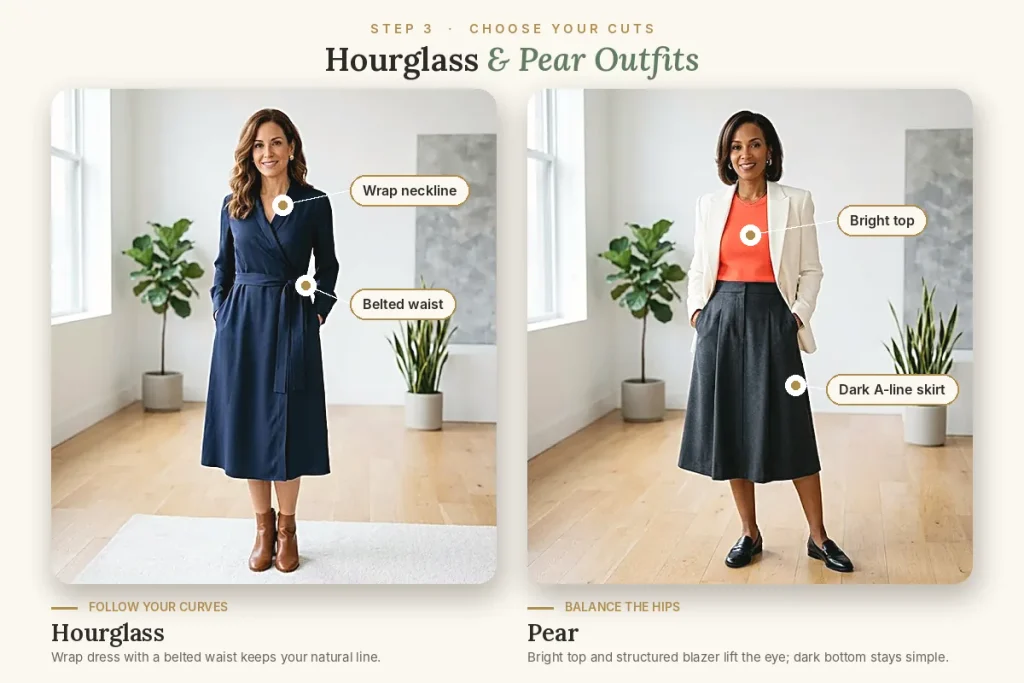
Your balanced proportions and defined waist are the main feature. Outfits for an hourglass body type work best when they follow your natural curves instead of hiding them. Look for pieces that mark the waist and let the shoulders and hips stay in proportion. Fabrics with a little stretch keep your lines clean without squeezing you.
- What works: Wrap tops and dresses, fitted jackets, belted coats, and high-rise bottoms
- Go carefully: Boxy, shapeless cuts that hide the waist
- Try this: Wrap top, high-rise straight trousers, and a structured blazer
Choosing Clothes for a Pear Body Type
The best clothes for a pear-shaped body bring visual weight to the upper half so everything feels balanced. Structured shoulders, bold necklines, and bright colors on top do the heavy lifting. Keep the lower half simple and darker. Wide-leg and straight-leg pants also help balance the hips.
- What works: Boat necks, statement tops, A-line skirts, and bootcut or straight pants
- Go carefully: Tight, light-colored bottoms paired with plain tops
- Try this: Bright patterned top, dark straight-leg pants, and a tailored jacket
Choosing Clothes for an Apple Body Type
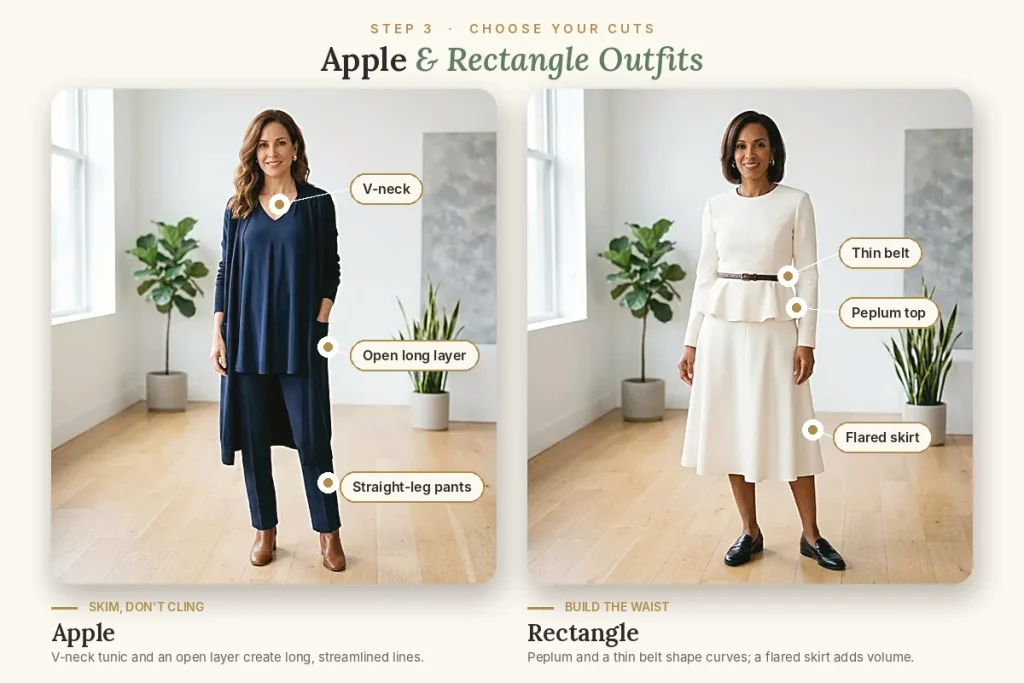
Draw attention to your arms, legs, and neckline. Choose fabrics that float over the midsection instead of clinging to it. Open layers create long vertical lines that make the torso look streamlined. Empire waists sit just under the bust and release into soft fabric.
- What works: V-necks, empire waists, open cardigans, long tunics, and straight-leg pants
- Go carefully: Clingy knits and tight waistbands
- Try this: V-neck tunic, straight-leg pants, and a long open layer
Choosing Clothes for a Rectangle Body Type
Your frame is straight and balanced. Clothes for a rectangle body shape can build curves with clever details. Belts, peplum hems, ruffles, and layers all create the look of a waist. Flared skirts and wide-leg pants add volume below. Mixed textures keep the outfit lively.
- What works: Belts, peplum tops, ruffles, layered looks, and flared skirts
- Go carefully: Very straight, stiff cuts from head to toe
- Try this: Peplum top, flared skirt, and a cinched belt
Choosing Clothes for an Inverted Triangle Body Type
Broad shoulders are your signature. The best clothes for an inverted triangle body type soften the top and add movement below. Scoop necks and raglan sleeves smooth the shoulder line. Pleated skirts and wide-leg pants build balance in the lower half.
- What works: Scoop or V-necks, raglan sleeves, wide-leg pants, and full skirts
- Go carefully: Heavy shoulder pads and puffy sleeves
- Try this: Soft scoop-neck top with wide-leg trousers
Best Clothes for Men With a Rectangle or Trapezoid Build
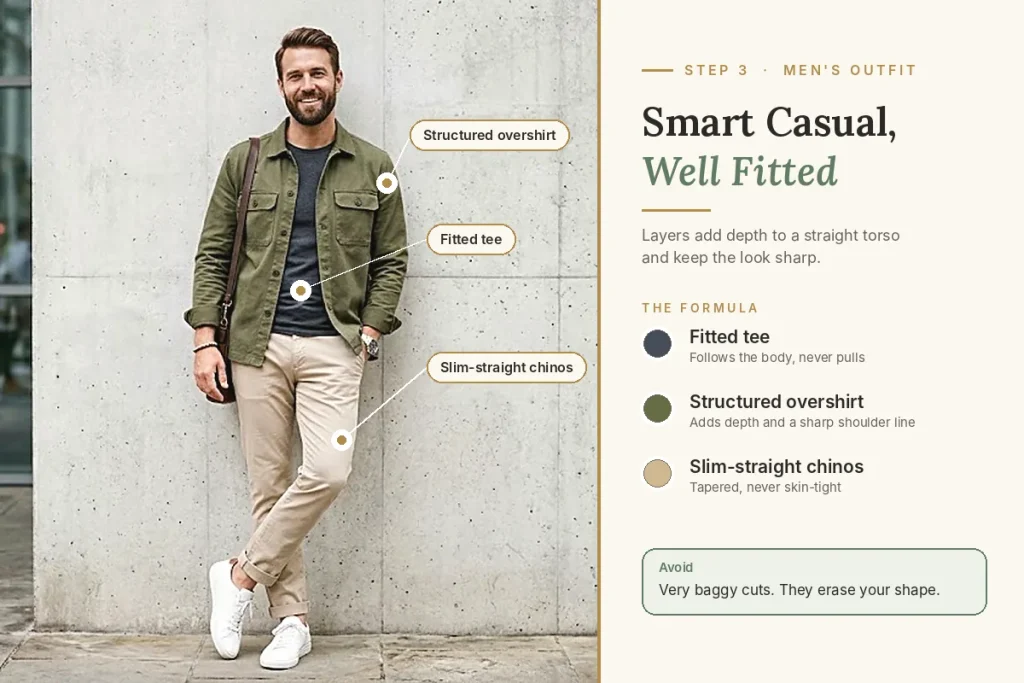
You have a balanced frame and plenty of options. Layers add depth to a straight torso. Structured overshirts, tailored trousers, and textured fabrics keep the look sharp. Avoid very baggy cuts since they erase your shape.
- What works: Layered jackets, structured overshirts, and slim-straight trousers
- Try this: Fitted tee, structured overshirt, and slim-straight chinos
Best Clothes for Men With a Triangle or Oval Build
Aim for clean lines and a smooth vertical flow. If you’re searching for clothes for men with a belly, the winning pattern is simple. Choose shirts that skim the body and end around mid-hip. Pick fabrics with a little weight. Keep trousers straight. Structured shoulders balance a fuller waist and single-color outfits create length.
- What works: Vertical stripes, mid-tone colors, structured shoulders, and straight-leg pants
- Go carefully: Shirts that pull at the buttons and ones that billow
- Try this: Dark overshirt, matching tee, and straight-leg pants
Best Clothes for Men With an Inverted Triangle Build
Your shoulders and chest already carry the look. Keep the rest relaxed so the silhouette stays balanced. Straight-leg trousers and softer fabrics on top work well. Super-slim pants can exaggerate the V.
- What works: Straight-leg trousers, open collars, and soft fabrics on top
- Go carefully: Very slim pants and heavily padded jackets
Best Jeans for Your Body Type
Jeans deserve their own mention since so many shoppers struggle with them. The best jeans for your body type depend mostly on rise and leg shape. Rise is the distance from crotch to waistband. It decides where the jeans sit on your torso.
- Hourglass: High-rise with stretch to follow the waist-to-hip curve
- Pear: Bootcut or straight leg with a slightly stretchy waistband
- Apple: Mid-rise straight leg with a wide, comfortable waistband
- Rectangle: Wide-leg or flared jeans to add lower-body volume
- Inverted triangle: Relaxed or wide-leg styles to balance broad shoulders
Quick Comparison: Clothes for Every Body Shape at a Glance
| Body type | Best tops | Best bottoms | Fabric tips | Go carefully |
| Hourglass | Wrap tops, fitted knits | High-rise straight or pencil | Stretch with soft drape | Boxy shapes |
| Pear | Boat neck, statement tops | A-line, bootcut | Structure on top, simple below | Tight light bottoms |
| Apple | V-neck, empire waist | Straight-leg | Fabrics that skim | Clingy knits |
| Rectangle | Peplum, ruffles | Flared skirts, wide-leg | Textures and layers | Stiff straight cuts |
| Inverted triangle | Scoop neck, raglan | Wide-leg, pleated | Soft and fluid | Shoulder pads |
| Male rectangle | Layered overshirts | Slim-straight | Structured cotton | Very baggy cuts |
| Male triangle or oval | Vertical lines | Straight-leg | Mid-weight and smooth | Tight shirts |
Step 4: Fabrics, Colors, and Patterns That Flatter Your Shape
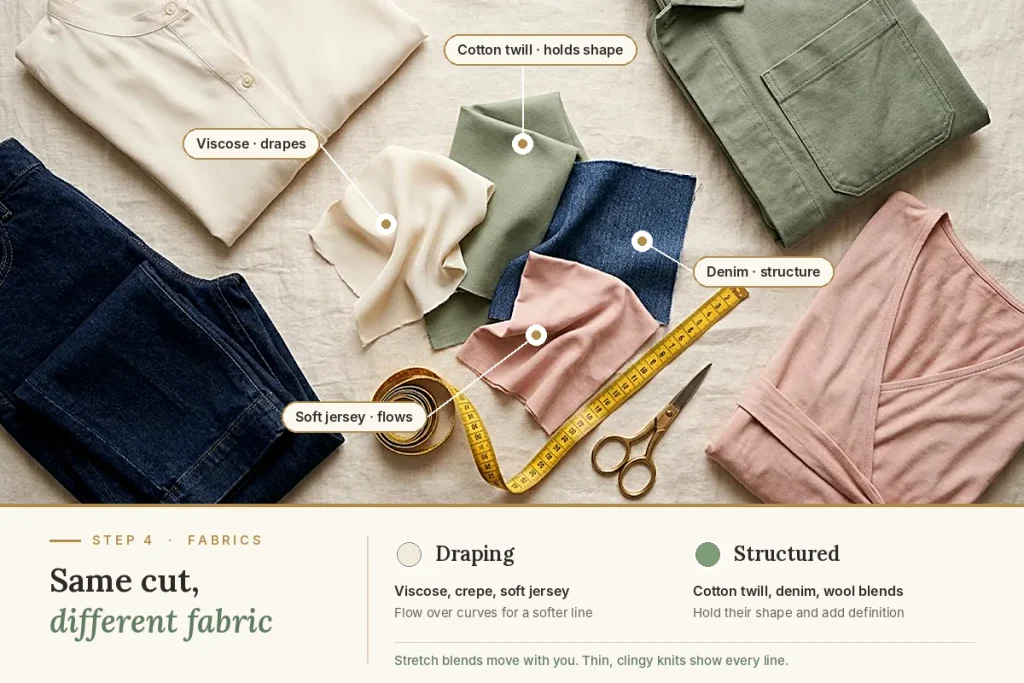
Two garments with the same cut can look completely different in different fabrics. That’s why fabric deserves its own step when you’re choosing clothes that fit your body type. A shirt dress in stiff cotton creates a crisp structured line. The same dress in drapey viscose falls softly. One suits a rectangle build. The other suits an apple shape.
How Fabric Changes the Way Clothes Fit Your Body Type
- Draping fabrics such as viscose, crepe, and soft jersey flow over curves and suit shapes that want softness
- Structured fabrics such as cotton twill, denim, and wool blends hold their shape and add definition
- Stretch blends follow the body and move with you
- Thin, clingy knits show every line, so wear them only when that’s your goal
Color Placement Tricks for Balancing Your Proportions
Color works like a spotlight. Darker shades recede and make an area look smaller. Lighter shades draw the eye and add visual volume. Monochrome outfits create one long unbroken line. Color blocking guides attention to the areas you choose. If you’re a pear shape, try a bright top with a dark bottom. If you’re an inverted triangle, flip the idea.
Patterns and Prints: Scale, Direction, and Placement
Large bold prints add volume while small prints stay subtle. Vertical lines stretch the body upward and horizontal lines widen it. Place your busiest print where you want attention to land. Keep quieter solids over the areas you’d rather not emphasize.
Step 5: The Fit Checklist Every Outfit Must Pass
You can pick the perfect cut and still end up with a poor fit. This checklist catches the problems before you leave the store or keep the delivery box.
Seven Fit Points to Check in the Mirror
| Fit point | What good looks like |
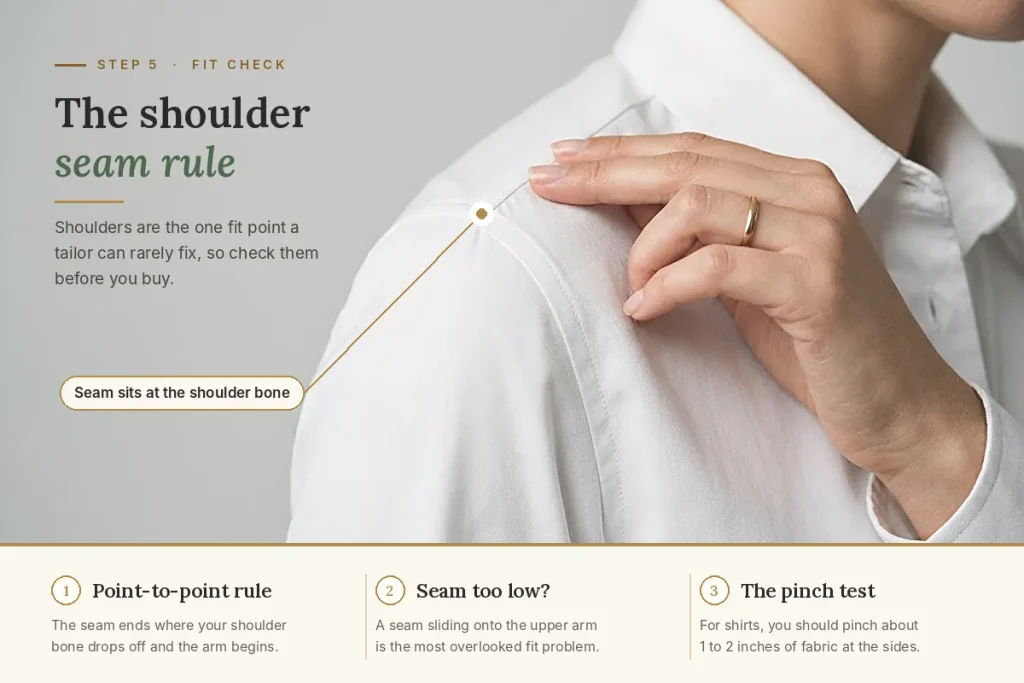
| Shoulder seam | Sits at the edge of your shoulder bone, not on the upper arm |
| Sleeve length | Ends at the wrist bone or wherever you intended |
| Chest or bust | Lies flat with no pulling or gaping |
| Waist placement | Lands at your natural waist and sits parallel to the floor |
| Rise | Sits comfortably with no digging or sagging |
| Hem length | Falls where it flatters your leg line |
| Movement | You can sit, reach, and walk with ease |
The shoulder seam deserves extra attention. Tailors call it the point-to-point rule. The seam should end exactly where your shoulder bone drops off and your arm begins. A seam that slides down onto the upper arm is one of the most overlooked fit problems. For shirts, try the pinch test. You should be able to pinch roughly one to two inches of fabric at the sides of your torso. Also remember that slim fit doesn’t mean tight fit. It means the garment follows your shape a little more closely.
Skirts follow similar rules. The waistline should sit parallel to the floor. The side seams should hang straight down without swinging toward the front or back. If a seam drifts, the skirt is twisting on your body.
When to Tailor Instead of Replace
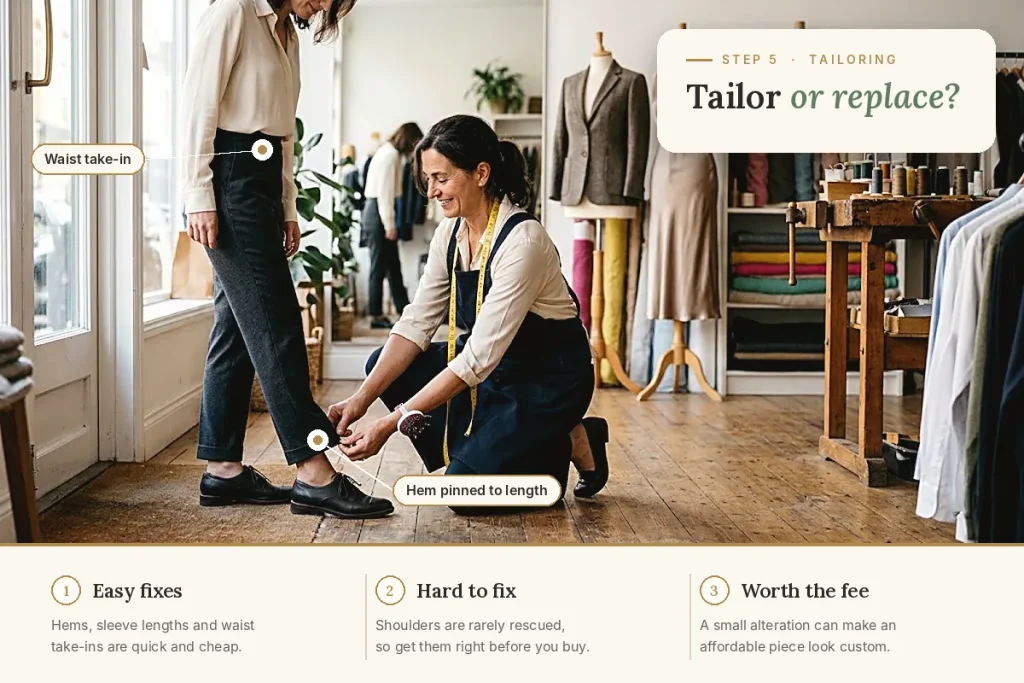
Some fixes are cheap and easy. Hems, sleeve lengths, and waist take-ins all fall in that group. Shoulders are the tough exception because tailors can rarely rescue them. Get the shoulders right before you buy and let a tailor handle the rest. A small alteration fee can make an affordable piece look custom. That’s often the best money you’ll spend on clothes.
Illustrative Case Study: Hira and the Closet of Almost-Right Clothes
Meet Hira, who owns a closet full of clothes that nearly work. Her trousers run a half-inch long. A favorite blazer has sleeves that pass her wrist. A dress gapes at the waist. She sorts everything into three piles: fix, keep, and let go. A tailor handles the hems, sleeves, and waist for a modest fee. Within a week she has a dozen outfits she actually wears. The lesson? Better fit often costs less than buying new.
Dressing for Different Parts of Your Life
Your body type stays the same while your days change. These quick pointers help you adapt the same principles to common situations.
- Work: Choose structured jackets and tailored trousers in your best cut. A well-fitted blazer is the single most useful layer.
- Everyday casual: Focus on rise, leg shape, and soft layers. Comfort should never fight your silhouette.
- Weddings and events: Pick a dress cut for your shape. Waist-defining styles suit hourglass and rectangle builds while flowing styles suit apple builds.
- Modest dressing: Create shape through cut and fabric instead of skin. Long tunics, structured layers, and soft drape all work well.
Common Mistakes When Choosing Clothes for Your Body Type
- Buying by size number. Fix: use your measurements, since sizes vary wildly between brands.
- Copying trends that clash with your proportions. Fix: adapt the trend to your shape instead of skipping it.
- Hiding in oversized clothes. Fix: choose pieces that skim your body because extra fabric often adds visual bulk.
- Ignoring height and torso length. Fix: adjust waist and hem placement to your frame.
- Skipping the sit-and-move test. Fix: sit, reach, and walk before you buy.
- Treating body type rules as strict laws. Fix: use them as starting points and trust the mirror.
A simple rule of thumb: if you can’t breathe, the outfit isn’t working.
Smart Shopping Tips for Finding Clothes That Suit Your Shape
- Try three sizes of the same item when you can
- Read size charts and fabric details closely when you shop online
- Check the return policy before you buy
- Build around a few reliable silhouettes that you love
- Photograph your outfit with your phone because photos show what mirrors hide
- Try AI outfit planners to organize your closet and test combinations
Building a Small Wardrobe Around Your Body Type
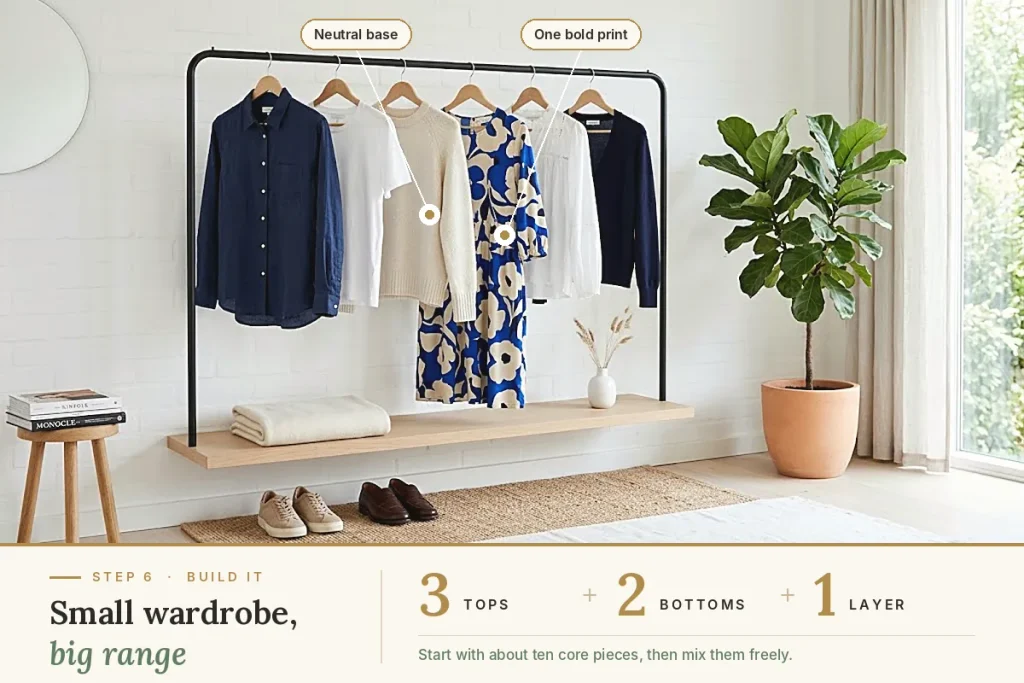
Once you know what works, a compact wardrobe is within reach. Start with about ten core pieces and mix them freely. A reliable formula is three tops, two bottoms, and one layer. That combination makes many different outfits without crowding your closet.
Illustrative Case Study: Mina and the Six-Piece Wardrobe
Picture Mina, who has a pear shape. She chooses three structured tops in navy, white, and a bold print. She adds two dark bottoms: straight trousers and an A-line skirt. A tailored blazer ties everything together. From six pieces she builds more than a dozen outfits. Each one balances her proportions and feels comfortable. She spends less time deciding each morning and more time enjoying what she wears.
FAQs About Choosing Clothes That Fit Your Body Type
How do I know which clothes fit my body type? Measure your shoulders, bust or chest, waist, and hips. Compare the numbers to find your dominant shape. Then use the shape-by-shape guide above to choose cuts, necklines, and fabrics.
What is the most flattering silhouette for every body type? No single silhouette suits everyone. As a starting point, structured and well-fitted pieces with clean lines work on most shapes.
Can I wear fitted clothes if I’m not slim? Absolutely. Fitted doesn’t mean tight. Clothes that follow your shape without squeezing usually look better than very loose ones.
How do I choose clothes if I’m between sizes? Size up and tailor down. It’s much easier for a tailor to take fabric in than to add it.
Does height change how I should dress for my body type? Yes. Shorter frames often need higher waistlines and shorter hems. Taller frames can wear longer lengths and bolder proportions.
What clothes make a big stomach look smaller? Choose fabrics that skim and don’t cling. V-necks, long open layers, and straight-leg pants help. Single-color outfits also create length.
Are body type rules still relevant today? They’re a useful starting point. Personal comfort and taste matter more than any rule.
How can I dress modestly and still choose clothes that flatter my shape? Focus on cut and fabric more than skin. Long tunics, structured layers, and soft drape can create shape while offering full coverage.
Final Thoughts: Dress the Body You Have Today
Choosing clothes that fit your body type comes down to five steps: measure, set a goal, pick the right cuts, choose smart fabrics, and check the fit. None of it needs a stylist or a big budget. It just takes a little attention. Keep your approach simple and your expectations kind.
Try the measurement exercise this week. Pull out three pieces you already own and run them through the fit checklist. Notice what works and what doesn’t. Then shop with that knowledge in your pocket. You deserve clothes that feel like they were made for you.