
A practical guide to quieting a racing mind with small daily habits for work, study, and home
It’s 2 a.m. Your body begs for sleep. Your brain, meanwhile, replays a clumsy comment from three years ago. Then it jumps to tomorrow’s meeting. Then to next month’s bills. An overactive mind works like a browser with 47 open tabs. Something is playing music somewhere and you can’t find it.

You don’t need a retreat or a pricey app to quiet that noise. Small habits, repeated daily, can calm an overactive mind better than most people expect. They cost nothing. They need no equipment. Each one takes ten minutes or less. Sleep alone shows how big the problem has grown. The CDC reported that more than a third of American adults don’t get at least seven hours of sleep on a regular basis. Poor sleep and a racing mind feed each other. You’ll meet ten simple habits that calm an overactive mind, see why each one works, and learn how to build them into a daily routine. Whether you study, work, or run a household, you’ll find something to try tonight.
Quick answer: the 10 simple habits that calm an overactive mind
- Slow breathing to settle a racing mind in minutes
- A daily brain dump to empty your head onto paper
- Scheduled worry time to give anxious thoughts a set slot
- Short outdoor walks to burn off nervous energy
- 5-4-3-2-1 grounding to pull your attention back to the present
- Single-tasking to stop the mental scatter
- Caffeine and screen limits to stop feeding the buzz
- A steady sleep routine to reset your mind every night
- Progressive muscle relaxation to release hidden tension
- Talking it out to shrink worries by sharing them
What Is an Overactive Mind? Signs and Causes
Common Signs of a Racing Mind

An overactive mind is a mind that won’t power down. Thoughts loop, jump, and pile up faster than you can sort them. Some people call it overthinking. Others call it mental chatter. The label matters less than the feeling: your head stays busy even when your body wants rest. Check whether any of these sound familiar:
- You lie awake while thoughts spin in circles
- You reread messages again and again before sending them
- You struggle to focus on one task for more than a few minutes
- “What if” questions fill your head all day
- You feel mentally drained by lunchtime
- Small decisions feel strangely heavy
Picture someone choosing a restaurant for forty minutes. Every option triggers a new worry. By the end, they’re too tired to enjoy dinner. That’s an overactive mind in action.
Why Your Mind Won’t Slow Down
Several everyday factors feed a busy mind. They often team up. Five drains show up again and again:
- Stress. Pressure at work, school, or home keeps your alarm system switched on.
- Information overload. Phones deliver a nonstop stream of news, messages, and alerts.
- Poor sleep. A tired brain struggles to filter and settle its own thoughts.
- Caffeine. It lingers in your body for hours and keeps you wired.
- Unfinished business. Open tasks and undecided choices nag at you like a dripping tap.
Psychologists have studied that last drain closely. In a well-known 2011 set of experiments, unfinished goals caused intrusive thoughts during an unrelated reading task. Knowing the causes gives you a map. Each habit below targets one or more of them.
Overactive Mind vs. Anxiety: What’s the Difference?
An overactive mind isn’t a medical diagnosis. It describes how thinking feels during stressful or overloaded stretches of life. Almost everyone experiences it at some point. Anxiety is different. When racing thoughts come with constant fear or physical symptoms and last for weeks, a healthcare professional can help sort out the cause. The habits in this guide support your well-being. They don’t replace professional care.
Why Simple Habits Calm an Overactive Mind
Small habits work because they speak to your body as well as your thoughts. Stress switches on your body’s alarm system. Your heart speeds up and your muscles tighten. Calming actions such as slow breathing, gentle movement, and steady sleep tell that system the danger has passed. Think of habits as training wheels. They hold you steady until balance becomes automatic. Over time your mind learns the way back to calm on its own.
The Roman philosopher Seneca captured the problem nearly 2,000 years ago: “We suffer more often in imagination than in reality.” An overactive mind lives in that imagined space. These habits pull you back into the present moment.
Honesty matters here too. Not every habit has the same amount of research behind it. Slow, paced breathing in general has reasonably solid support. Box breathing specifically has less. One recent review of small trials found short-term relief from stress in several studies but not in all of them. Treat these habits as practical coping skills. They aren’t cures. Choose one or two first and give them a full week. Stacking all ten on day one is a classic recipe for quitting.
What Makes a Habit Worth Trying
Plenty of calming advice sounds lovely but fails in real life. These ten habits passed five simple checks:
- Costs nothing. No app, class, or gadget required.
- Takes ten minutes or less. You can fit it into a busy day.
- Works almost anywhere. Home, office, campus, or commute.
- Shows results fast. You should feel a small shift in your first session.
- Easy to learn. Nothing here demands training.
Quick Comparison: Habits to Calm an Overactive Mind at a Glance
| Habit | Best for | Time needed | Watch out for |
| Slow breathing | Sudden stress | 2-5 min | Breath-holds don’t suit everyone |
| Brain dump | Nighttime overthinking | 5 min | Don’t edit as you write |
| Worry time | Daily worry loops | 15-30 min | Not right before bed |
| Outdoor walk | Mental fog | 10-20 min | Skip the phone scrolling |
| 5-4-3-2-1 grounding | Spirals in public | 2 min | Practice when calm too |
| Single-tasking | Scattered focus | 20 min | Silence notifications first |
| Caffeine and screen limits | Restless evenings | All day | Cut back gradually |
| Sleep routine | Racing thoughts at bedtime | 20 min | Needs steady timing |
| Muscle relaxation | Physical tension | 8-10 min | Tense gently, never to pain |
| Talking it out | Heavy worries | 10-15 min | Pick a trusted listener |
The 10 Simple Habits That Calm an Overactive Mind
1. Practice Slow Breathing to Calm a Racing Mind
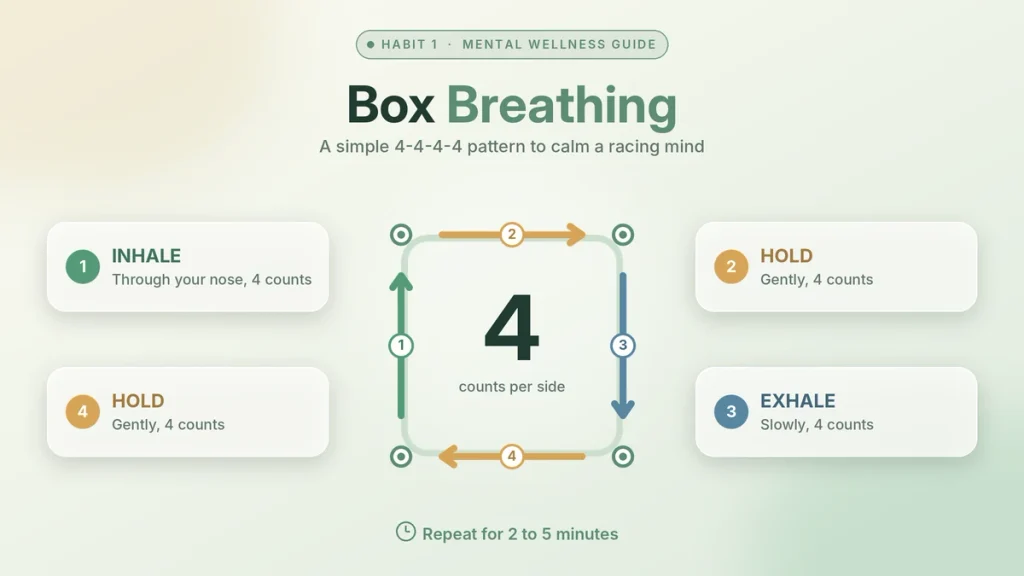
Start here if you’ve never tried a calming habit. Breathing is the one part of your stress response you can steer directly. Long, slow exhales nudge your body toward rest. Studies show that slow, deep breathing soothes the stress response and activates the parasympathetic nervous system. That’s the system that handles resting functions such as heart rate and digestion. Breathing exercises to calm a racing mind work best when you practice them daily. Then they feel natural when stress hits. Try box breathing:
- Inhale through your nose for four counts.
- Hold gently for four counts.
- Exhale slowly for four counts.
- Hold for four counts.
- Repeat for two to five minutes.
Prefer something softer? The 4-7-8 method, popularized by Dr. Andrew Weil, stretches the exhale even longer. Breathe in for four, hold for seven, and exhale for eight.
- Time needed: 2 to 5 minutes.
- Try this: Practice once a day while you feel fine so the skill is ready when you don’t.
- Watch out: People with heart or lung conditions, or who are pregnant, should check with a doctor before breath-holding. If holds feel uncomfortable, skip them and simply lengthen your exhale.
2. Do a Daily Brain Dump to Quiet an Overactive Mind
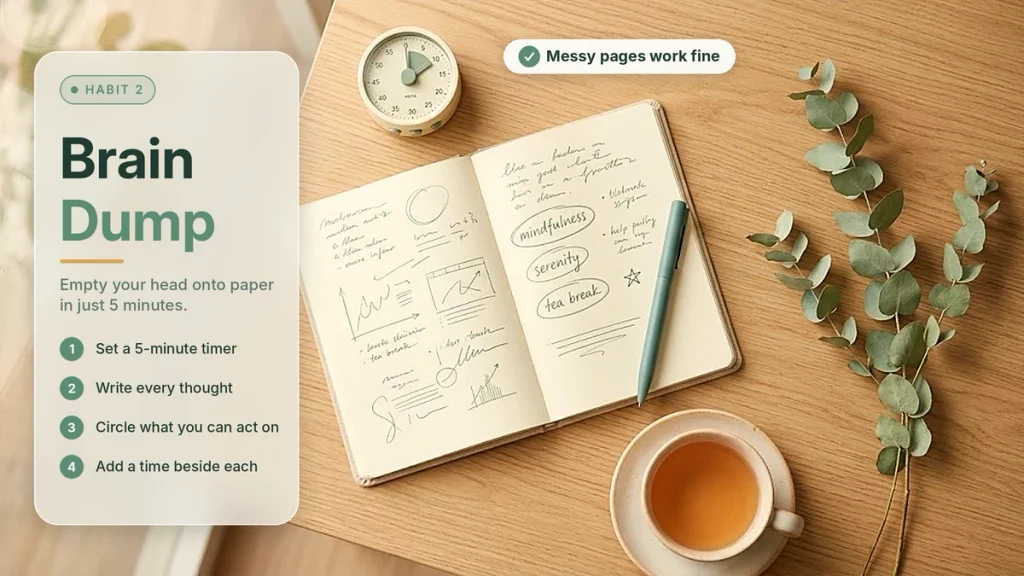
Unfinished tasks love to nag. A brain dump gets them out of your head and onto paper, much like emptying your pockets at the end of a long day. Set a timer for five minutes. Write every thought that crosses your mind without judging it. Worries, errands, random ideas, and half-finished plans all belong on the page. The science backs this up. Psychologists E.J. Masicampo and Roy Baumeister found that unfinished goals caused intrusive thoughts. Letting people make a specific plan for those goals eliminated the effect. The plan didn’t even have to be carried out first. That’s why the second step matters. Next to each item, write when you’ll deal with it. This habit is a gem for anyone wondering how to stop a racing mind before bed.
- Time needed: 5 minutes.
- Try this: Circle only the items you can act on tomorrow. Add a time beside each one.
- Watch out: Don’t edit or rewrite the list. Messy pages work fine.
3. Schedule Worry Time to Soothe an Overthinking Mind
Worrying all day wears you out. Scheduled worry time flips the script. Therapists call the method stimulus control. Researchers have studied it for decades. You notice a worry, set aside a specific time and place to think about it, and postpone it until then. When your worry time arrives, you use it to solve the problems your worries raise. A Dutch study published in 2011 tested the approach on people struggling with burnout and work problems. Those who confined their worrying to one scheduled 30-minute period coped better. Even the researchers caution that part of the benefit may come from expectation. Still, the technique costs nothing and carries almost no risk.
Picture a student who postpones exam anxiety until 6 p.m. Afternoon study sessions suddenly feel lighter. When worry time arrives, many people find half the concerns have already shrunk.
- Time needed: 15 to 30 minutes, once a day.
- Try this: Use the same time and place daily. Keep a notepad nearby for worries that pop up earlier.
- Watch out: Avoid scheduling it right before bed. And postpone worries instead of pushing them away. Jot a note and promise yourself you’ll return to it.
4. Take a Short Walk Outside to Clear a Busy Mind

Movement burns off nervous energy. A ten-minute stroll can clear mental fog and break a thought loop. The World Health Organization recommends that adults do at least 150 to 300 minutes of moderate aerobic activity per week. It also notes that physical activity helps prevent and manage mental health conditions. Short walks count toward that goal. Three ten-minute walks a day, five days a week, add up to exactly 150 minutes. Leave your phone behind if you can. Notice three sounds and three colors as you go. Fresh air and natural light add a bonus lift.
- Time needed: 10 to 20 minutes.
- Try this: Walk right after lunch or right after a stressful call.
- Watch out: Scrolling while you walk defeats the purpose.
5. Try the 5-4-3-2-1 Grounding Exercise to Calm Overthinking
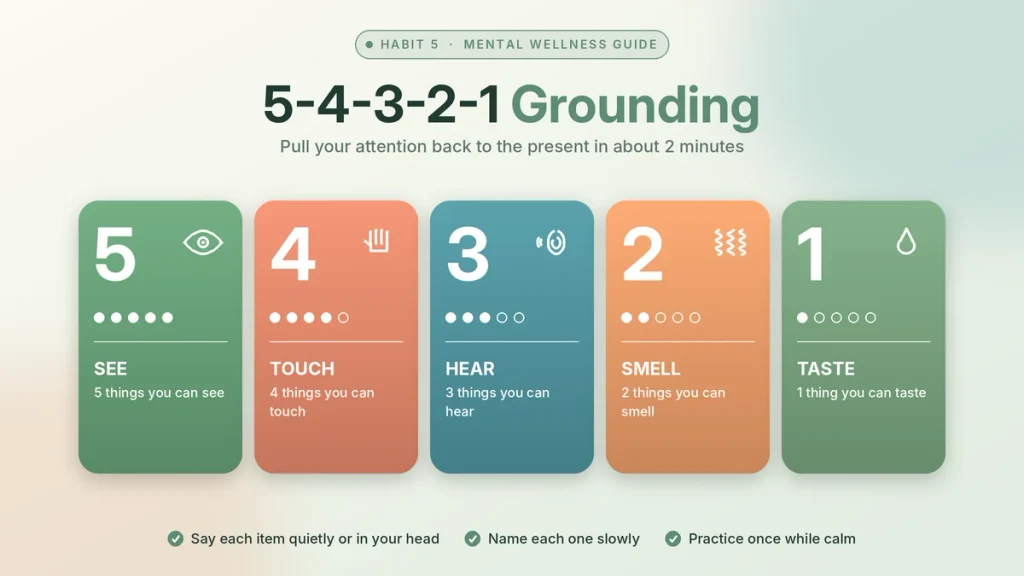
Grounding techniques for overthinking pull your attention out of your head and into your senses. The 5-4-3-2-1 method takes about two minutes:
- 5 things you can see
- 4 things you can touch
- 3 things you can hear
- 2 things you can smell
- 1 thing you can taste
Say each item quietly or in your head. This exercise shines during sudden spirals at work, in traffic, or before a big conversation. Your brain can’t fully chase a worry while it hunts for the sound of a ticking clock.
- Time needed: About 2 minutes.
- Try this: Practice once while calm so it feels familiar when you need it.
- Watch out: Don’t rush. Name each item slowly.
6. Practice Single-Tasking to Stop the Mental Scatter
Multitasking sounds productive but it scatters your focus. Every switch between tasks costs mental effort. That cost adds up to a tired, buzzing brain. Single-tasking does the opposite. Pick one task and work on it for 20 minutes with notifications silenced. Use a simple timer. When it rings, take a two-minute break and choose the next task. Think of it as one foot in front of the other. This habit sharpens mental clarity and shrinks the feeling of having too many things going on at once.
- Time needed: 20-minute blocks.
- Try this: Put your phone in another room during each block.
- Watch out: Keep a notepad handy for stray thoughts. Write them down and return to your task.
7. Cut Back on Late Caffeine and Doomscrolling
Two sneaky culprits keep minds wired: late caffeine and endless news feeds. The Sleep Foundation reports that caffeine’s half-life ranges from about 2 to 12 hours depending on the person. Its effects begin after roughly 30 minutes and can last five hours or longer. The generally recommended cutoff is at least eight hours before bedtime. If you go to bed at 11 p.m., that means your last coffee by 3 p.m. Doomscrolling adds a steady drip of alarming headlines to a brain that already feels alert. Try these swaps:
| Instead of… | Try… |
| Afternoon coffee | Herbal tea or warm water with lemon |
| Late-night news feed | A paper book or calm music |
| Scrolling in bed | A “screens off” time one hour before sleep |
| Energy drinks | A short walk and a glass of water |
- Time needed: No extra time. You simply shift habits.
- Try this: Set a daily caffeine cutoff alarm.
- Watch out: Cutting caffeine suddenly can cause headaches. Taper over a few days.
8. Build a Steady Sleep Routine to Calm Your Mind at Night
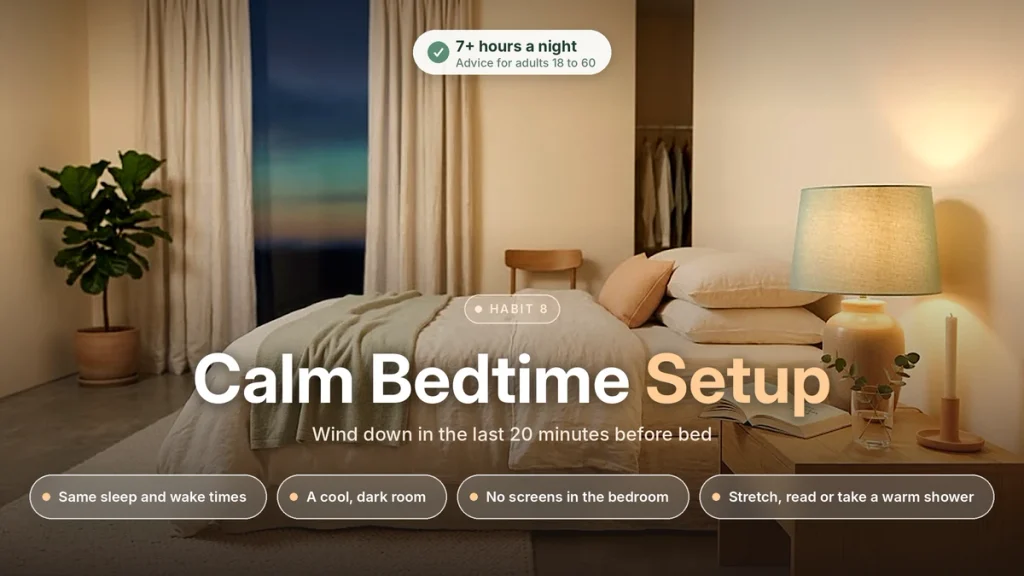
Sleep and an overactive mind feed each other. Poor sleep fuels racing thoughts. Racing thoughts steal sleep. Break the cycle with a routine. The American Academy of Sleep Medicine and the Sleep Research Society recommend that adults aged 18 to 60 sleep at least seven hours each night. The CDC links sleeping less than that with frequent mental distress. Its own tips include going to bed and rising at the same times every day and removing screens from the bedroom. Keep your room cool and dark. Spend the last 20 minutes before bed on something gentle, such as stretching, reading, or a warm shower. If you’re searching for how to calm an overactive mind at night, this habit anchors every other tip on this list.
- Time needed: A 20-minute wind-down.
- Try this: Pick a fixed wake-up time first. Bedtime follows naturally.
- Watch out: Weekend sleep-ins can undo your progress.
9. Use Progressive Muscle Relaxation to Soothe a Busy Mind
A busy mind often hides a tense body. Progressive muscle relaxation (PMR) teaches you to release that tension on purpose. American physician Edmund Jacobson developed it in the 1920s. His theory held that physical relaxation can promote mental relaxation. The American Academy of Sleep Medicine rated PMR an effective non-drug treatment for chronic insomnia back in 1999. Lie down or sit comfortably. Starting at your toes, tighten one muscle group for about five seconds. Then let go and notice the difference. Move upward through calves, thighs, stomach, hands, arms, shoulders, and face. Many people feel their thoughts slow down as their muscles soften. It works beautifully in bed.
- Time needed: 8 to 10 minutes.
- Try this: Breathe out slowly each time you release a muscle group.
- Watch out: Tense gently. Never squeeze to the point of pain.
10. Talk It Out With Someone You Trust

Worries grow in silence. Saying them aloud often shrinks them down to size. Call a friend, chat with a family member, or send a voice note to someone you trust. You don’t need advice. Simply being heard lifts a surprising weight. Connection is one of the oldest stress-management tools humans have. Try conversation starters like these:
- “Can I think out loud with you for five minutes?”
- “Something’s been rattling around in my head. Mind if I share?”
- Time needed: 10 to 15 minutes.
- Try this: Tell the listener whether you want advice or just an ear.
- Watch out: Choose someone calm. Avoid people who amplify your worries.
How to Build a Daily Routine That Calms an Overactive Mind
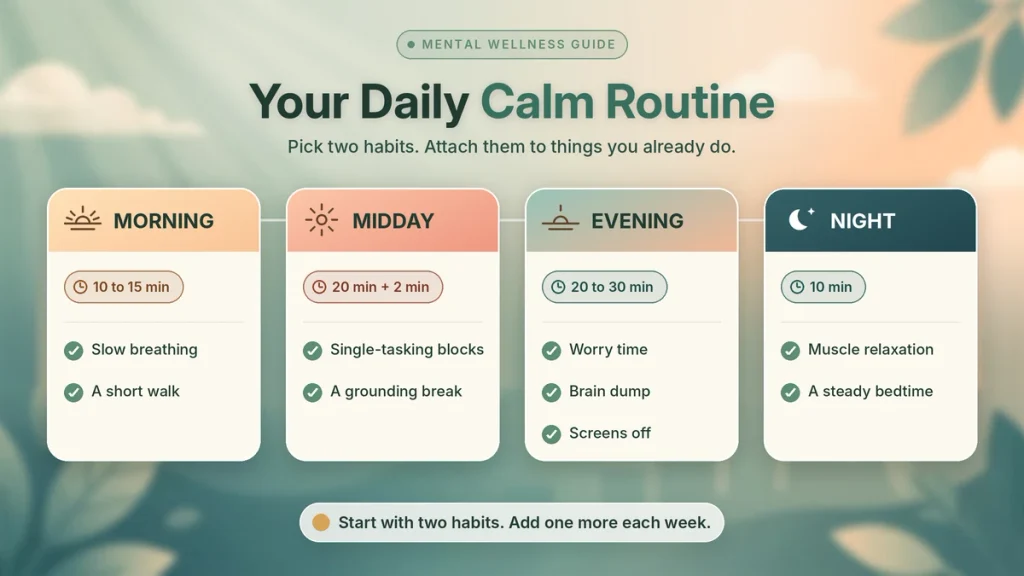
One habit helps. A small routine transforms your week. The trick is to keep it simple. Most people quit because they try too much at once. So pick two habits and attach them to things you already do.
A Simple Daily Routine
| Time of day | Habit | Duration |
| Morning | Slow breathing and a short walk | 10-15 min |
| Midday | Single-tasking blocks and a grounding break | 20 min + 2 min |
| Evening | Worry time, brain dump, and screens off | 20-30 min |
| Night | Muscle relaxation and a steady bedtime | 10 min |
A 7-Day Starter Plan
| Day | Add this habit | Time |
| Day 1 | Slow breathing | 3 min |
| Day 2 | Brain dump before dinner | 5 min |
| Day 3 | Ten-minute walk | 10 min |
| Day 4 | Caffeine cutoff alarm | 0 min |
| Day 5 | Screens off one hour before bed | 0 min |
| Day 6 | Muscle relaxation in bed | 8 min |
| Day 7 | Talk to someone you trust | 10 min |
Pick a Stack That Fits Your Life
- Students: Worry time before exams, single-tasking study blocks, and a steady sleep routine.
- Busy professionals: Slow breathing between meetings, a midday walk, and an evening brain dump.
- Home and family: Grounding during chaotic moments, a short walk after meals, and talking it out with a partner or friend.
Illustrative Case Study: Sara, the Marketing Coordinator
Meet Sara, a busy marketing coordinator. Most nights she lay awake until 1 a.m. while her mind replayed work conversations. She felt foggy all day and reached for more coffee to cope. Instead of overhauling her life, she picked three habits. She started a five-minute brain dump after dinner. She set a screens-off time of 10 p.m. And she practiced box breathing in bed.
During the first few nights nothing dramatic changed. By the end of week two, she fell asleep faster and woke up less groggy. She also dropped her afternoon coffee without much effort. None of her changes felt big. Together they reshaped her evenings. (This scenario is an example with estimated results, not a real person.)
Illustrative Case Study: Omar, the University Student
Picture Omar, a university student facing finals. Every study session ended with him doom-scrolling and panicking about grades. He tried scheduled worry time at 6 p.m. each day. He wrote every exam fear on one page and listed one action beside each. He also added a ten-minute walk after lunch and 20-minute single-tasking study blocks. Within two weeks his study sessions felt calmer and more focused. He still felt nervous before exams. But the worry no longer ran his whole day. (Again, an example with estimated results.)
Free and Practical: Habits for Any Budget and Setting
Everything Here Costs Nothing
Many wellness plans quietly assume you can pay for apps, classes, or gadgets. These habits don’t. Breathing, grounding, journaling, walking, and muscle relaxation need only a few minutes and a notebook. Nothing requires an internet connection or a special account. Start with whatever fits your day. Add more when you feel ready.
Quiet Options for Shared Homes and Busy Places
Not everyone has a private room. In a shared home, a crowded office, or a noisy commute, choose silent habits. Slow breathing, 5-4-3-2-1 grounding, and a pocket-notebook brain dump work almost anywhere. Nobody needs to know you’re doing them. Save longer practices such as muscle relaxation for bedtime.
A Note on Safety
- Skip breath-holds if you have heart or lung conditions or you’re pregnant. Check with a doctor first.
- Caffeine lingers twice as long in pregnant people, so earlier cutoffs help even more.
- Stop any exercise that causes pain or dizziness.
When Habits Aren’t Enough: Signs It’s Time for Professional Help
Habits help many people. They aren’t a cure-all. Reaching out for support is a sign of strength and not weakness. Use this table to decide:
| Signal | What it may mean | Action |
| Racing thoughts last for weeks | More than everyday stress | Talk to a doctor or licensed therapist |
| Sleep stays poor despite a routine | A sleep or anxiety issue | Book a medical checkup |
| Worry blocks work, school, or relationships | You need tailored support | Seek professional counseling |
| Constant fear or physical symptoms | Possible anxiety or a physical cause | Get a medical evaluation |
| Thoughts of harming yourself | This is urgent | Contact local emergency services or a trusted person right away |
This article offers general education. It doesn’t replace personalized medical advice.
Mistakes That Keep a Racing Mind Running
Even great habits backfire when people trip over the same few mistakes. Watch for these:
- Trying all 10 habits at once. Fix: start with two and add one each week.
- Fighting your thoughts. Fix: notice them, name them, and let them pass like clouds.
- Quitting after two days. Fix: give any habit at least seven days.
- Using screens as relaxation. Fix: swap scrolling for a book, music, or stretching.
- Practicing only when stressed. Fix: rehearse breathing and grounding while you feel fine.
- Scheduling worry time too close to bedtime. Fix: move it to late afternoon or early evening.
FAQs About Calming an Overactive Mind
How do I calm an overactive mind at night? Start with a brain dump to empty your thoughts onto paper. Then switch off screens and try slow breathing or progressive muscle relaxation. Keep your room cool and dark. A steady bedtime helps too. Together these steps tell your brain the day is finished.
What is the fastest way to quiet a racing mind? Slow breathing works fastest for most people. Inhale for four counts and exhale for six to eight counts. Do this for two minutes. If thoughts still spin, add the 5-4-3-2-1 grounding exercise to pull your attention into your senses.
Can simple habits really calm an overthinking mind? Yes, for many people. Small habits reduce stress, improve sleep, and train your attention. They won’t erase every worry. They do make worries easier to handle. Consistency matters more than intensity.
How long does it take for these habits to work? Breathing and grounding can help within minutes. Sleep routines and worry time usually take one to three weeks to show clear results. Track how you feel each day to spot progress.
Is an overactive mind a sign of anxiety? Not always. Stress, poor sleep, and overload can all cause a busy mind. Persistent racing thoughts along with constant fear or physical symptoms may point to anxiety. A healthcare professional can help sort out the cause.
Which habit should I try first? Start with slow breathing or a five-minute brain dump. Both take minutes and need nothing but a quiet spot.
Do I need an app or special equipment? No. Every habit here works with a notebook, a timer, and your own body.
Final Thoughts: Start With One Habit Tonight
A calmer mind doesn’t arrive overnight. It grows from small, steady choices: a slow breath, a short walk, a page of scribbled worries, a phone left in another room. These 10 simple habits that calm an overactive mind give you a menu to choose from. Keep your stack small and your expectations realistic.
Pick two habits this week. Use them for seven days. Notice what shifts. In two weeks you’ll know exactly which ones deserve a permanent place in your routine.