A practical guide to the physical, emotional, and behavioral signs of burnout, plus what to do next
You hit snooze for the fourth time. Your to-do list stares back. You don’t feel panicked or even stressed. You feel flat, like someone pulled your plug. Plenty of people shrug this off as “a rough week.” Yet it’s one of the classic burnout warning signs you shouldn’t ignore.
This guide walks you through the signs of burnout across your body, your mood, and your habits. You’ll learn how burnout differs from plain stress, how it builds over time, and what to do when you spot the early signs of burnout. Grab a coffee (or tea) and settle in.
Quick answer: 10 burnout warning signs at a glance
- Exhaustion that sleep doesn’t fix
- Growing cynicism about your work or responsibilities
- Feeling ineffective no matter how hard you try
- Constant irritability over small things
- Trouble sleeping or waking in the middle of the night
- Frequent headaches, muscle tension, or stomach trouble
- Pulling away from friends, family, and coworkers
- Procrastination that’s out of character for you
- Dread every Sunday night or before every shift
- Unhealthy coping habits like endless scrolling, skipped meals, or too much caffeine
What Is Burnout? Understanding the Warning Signs of Burnout
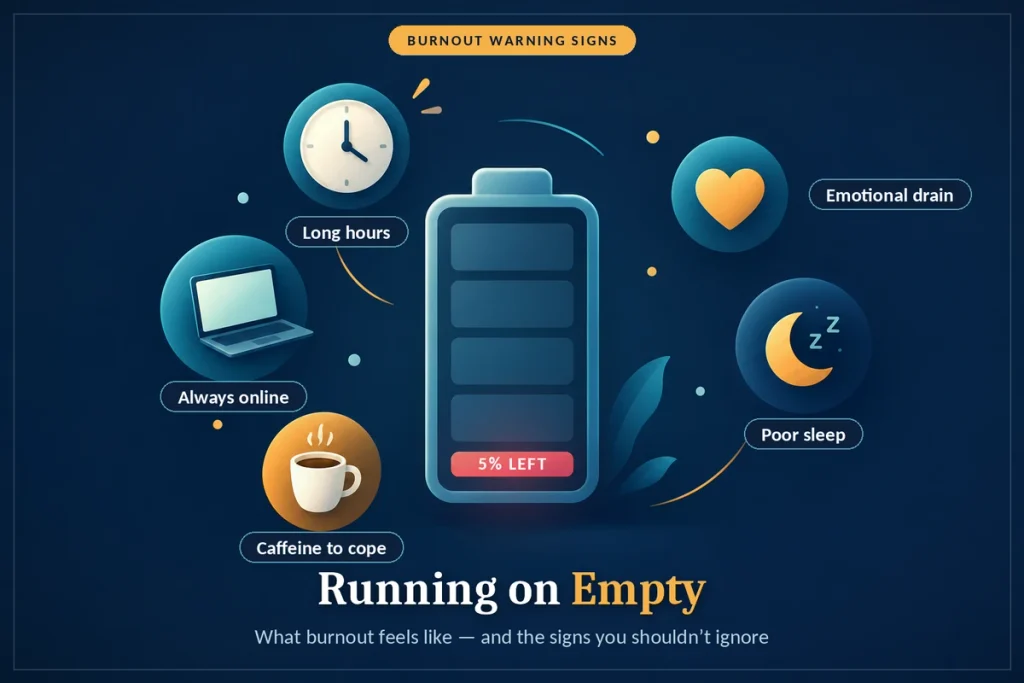
Before you can spot the warning signs of burnout, you need a clear picture of what it is. Burnout isn’t just “being tired.” It’s a deep, lasting state of depletion that builds when pressure outruns recovery for too long.
The Official Definition of Burnout
The World Health Organization took a firm stance on this in 2019. The ICD-11 classified burnout as an occupational phenomenon that comes from chronic workplace stress that hasn’t been managed well. The WHO’s own wording describes it as stress “that has not been successfully managed”. Note the careful language here. It’s called a phenomenon, not a medical condition. That doesn’t make it fake or minor. It simply means doctors don’t treat it as a stand-alone disease. People still suffer from it, and the burnout symptoms can hit hard.
The Three Core Dimensions of Burnout
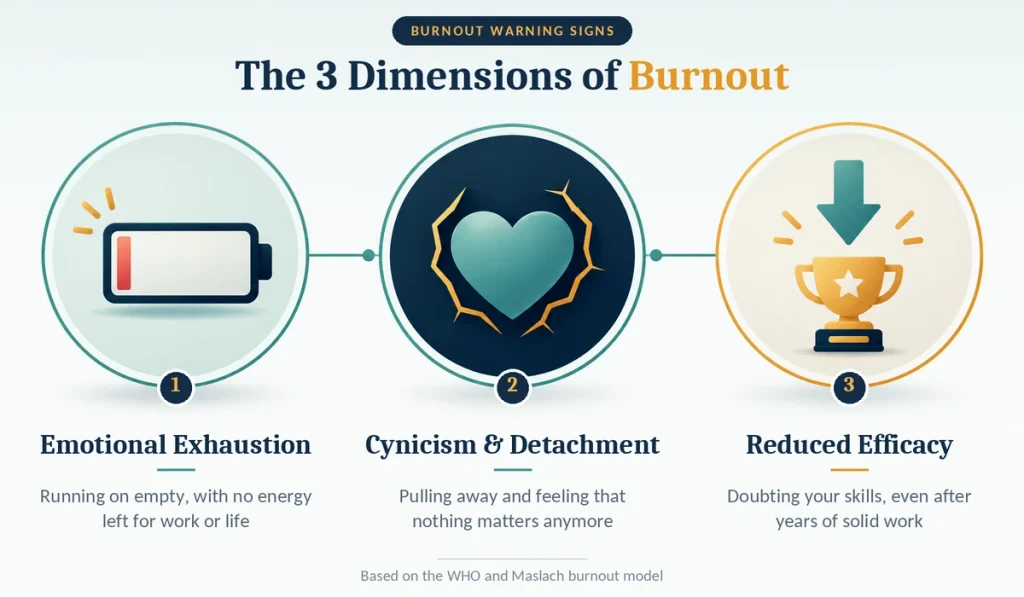
Researchers describe burnout through three connected pieces. The first is energy depletion or exhaustion. The second is growing mental distance from your job, along with negativity or cynicism. The third is reduced professional efficacy. In plain words: you’re drained, you’ve stopped caring, and you feel like you’re failing anyway.
Psychologist Christina Maslach shaped this model. She and her colleagues created the Maslach Burnout Inventory in 1981, and it remains a widely used measure. Her research also suggested the three symptoms tend to appear one after another.
| Dimension | What it feels like | Everyday example |
| Emotional exhaustion | Running on empty | Dreading a task you once handled easily |
| Cynicism / detachment | “Nothing matters anymore” | Rolling your eyes at projects that used to excite you |
| Reduced efficacy | “I’m not good at this” | Doubting yourself after years of solid work |
Is Burnout a Mental Illness?
Short answer: no, not on its own. Burnout isn’t listed as a mental illness. Still, it can overlap with anxiety or depression. Burnout and depression can be hard to tell apart because some symptoms overlap. If you’re unsure which one you’re facing, a professional can help sort it out.
Burnout Isn’t a Weakness
Here’s a point worth repeating. Experts urge people to see burnout as a workplace design problem, not a personal weakness. Think of a phone running fifty apps with a worn-out battery. The phone isn’t lazy. It’s overloaded. You work the same way.
Physical Signs of Burnout Your Body Is Sending You
Your body often waves the red flag before your mind admits anything. The physical signs of burnout can look like a dozen unrelated problems. Together they paint a clear picture.
Exhaustion That Rest Doesn’t Fix
Normal tiredness feels different. After a hard day, a good night’s sleep usually restores you. With burnout, you wake up already worn out. A weekend off barely makes a dent. This mental exhaustion and bodily fatigue combo is often the very first signal.
Sleep Problems and Racing Thoughts
Have you ever lain awake replaying tomorrow’s meeting for the tenth time? Many burned-out people struggle to fall asleep or wake at 3 a.m. with a pounding mind. Poor sleep then drains you further. That’s a nasty loop.
Headaches, Muscle Tension, and Frequent Illness
Stress that never lets up shows up in your shoulders, jaw, and stomach. You might catch every cold that circles the office. Prolonged work stress has also been linked to cardiovascular issues such as higher blood pressure. These symptoms can have other causes too. So if they stick around, book a checkup rather than guessing.
Common physical burnout symptoms include:
- Constant fatigue and low energy
- Tension headaches or migraines
- Back, neck, or shoulder pain
- Stomach upset or appetite changes
- Getting sick more often than usual
- A racing heart during ordinary tasks
Emotional Warning Signs of Burnout You Shouldn’t Ignore
Feelings matter just as much as physical clues. The emotional signs of burnout tend to creep in quietly. Many people don’t notice them until a friend points them out.
Cynicism and Detachment
This one stings because it feels like losing a piece of yourself. Work that once gave you pride now feels pointless. You might think, “Who even cares?” That attitude is the cynicism dimension at work. It acts like armor. You stop caring so it can’t hurt anymore.
Irritability and a Short Fuse
Small things suddenly feel huge. A colleague’s chewing, a slow email reply, a child’s question at the wrong moment. You snap and then feel guilty. Constant irritability is one of the most common burnout red flags because it affects everyone around you.
Dread, Numbness, and Feeling Trapped
Do you feel your stomach drop on Sunday evenings? Those “Sunday scaries” turn into a weekly storm when burnout takes hold. Some people also feel numb instead of anxious. Others feel stuck, as if no exit exists. Both reactions deserve attention.
Behavioral Burnout Symptoms Others May Notice First
Sometimes the people around you spot the change before you do. Behavioral burnout symptoms show up in how you act day to day.
Procrastination and Missed Deadlines
You used to finish tasks in an hour. Now they swallow the whole afternoon. Procrastination here isn’t laziness. Your brain is protecting you from more demands. Experts even list noticing procrastination as one sign to watch.
Withdrawing From People
You skip calls, cancel plans, and go quiet in group chats. Pulling away feels easier in the moment. Over time, though, isolation makes everything heavier.
Unhealthy Coping Habits
Extra coffee, late-night scrolling, skipped meals, or constant snacking can all signal strain. No need for judgment here. These habits are your mind’s shortcuts for feeling better fast. Spotting them is simply useful information.
Burnout vs. Stress vs. Depression: What’s the Difference?
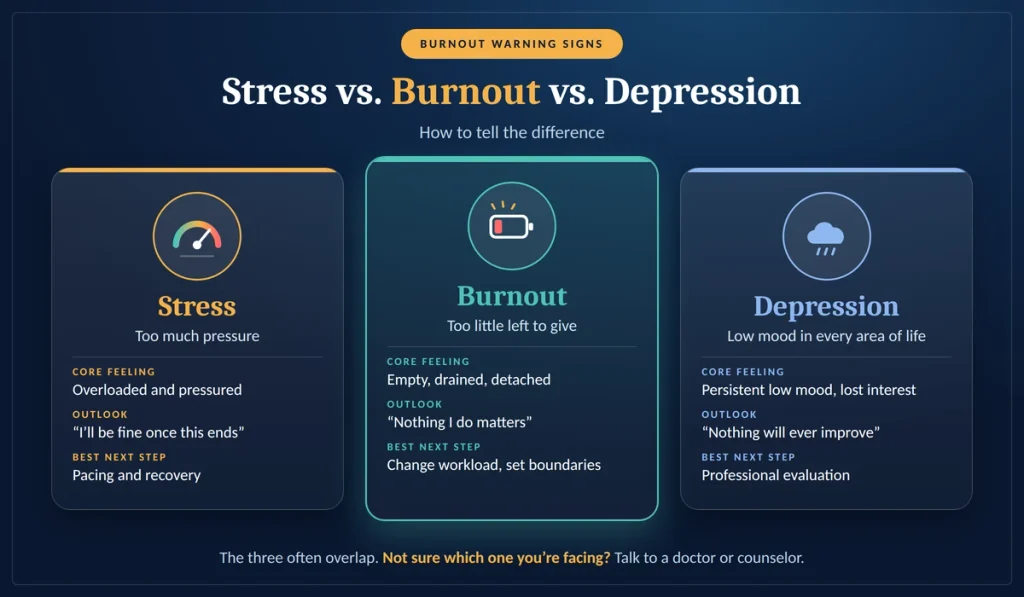
Many readers search for the burnout vs stress difference because the two feel so alike. Here’s a simple way to separate them. Stress usually means too much pressure, while burnout is about having too little left to give. Depression, meanwhile, reaches into every part of life.
| Feature | Stress | Burnout | Depression |
| Core feeling | Overloaded and pressured | Empty, drained, detached | Persistent low mood, lost interest |
| Energy | Urgent and overactive | Depleted | Depleted |
| Scope | Tied to specific demands | Usually tied to work or caregiving | Affects all areas of life |
| Outlook | “I’ll be fine once this ends” | “Nothing I do matters” | “Nothing will ever improve” |
| Best next step | Pacing and recovery | Change workload, set boundaries, find support | Professional evaluation |
Notice the pattern? With stress you feel like you’re drowning. With burnout you feel like you’ve run dry. If your low mood spreads beyond work into hobbies, relationships, and daily joy, talk with a professional about burnout vs depression symptoms.
How Burnout Creeps In: The Early Signs of Burnout Timeline
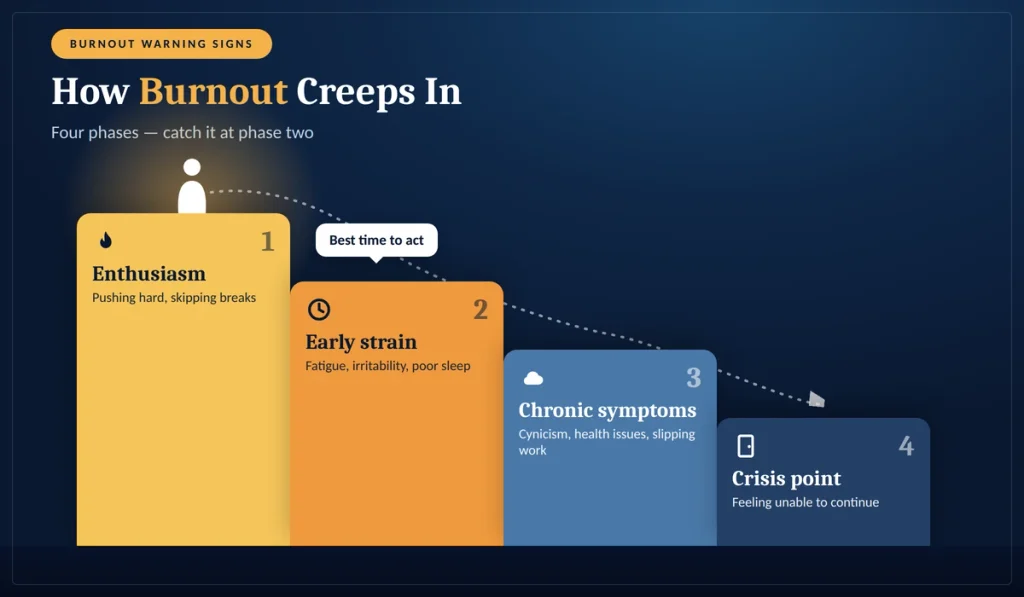
Burnout rarely arrives overnight. It builds gradually, with subtle signs at first that grow worse over time. HelpGuide suggests treating early symptoms as red flags that deserve attention. Here’s a simple four-phase view:
- Enthusiasm with overwork. You push hard and skip breaks. Everything feels exciting but unsustainable.
- Early strain. Fatigue, irritability, and sleep dips appear. These are the early signs of burnout at work that most people wave away.
- Chronic symptoms. Cynicism grows, health complaints pile up, and performance slips.
- Crisis point. You feel unable to continue. Many people quit, collapse, or need extended leave at this stage.
The best time to act is phase two. A small adjustment then beats a big rescue later.
Who Is Most at Risk? Common Groups and Their Burnout Symptoms
Anyone can hit this wall. Some groups face higher odds because of how their days are built.
- Healthcare workers: Long shifts and emotional weight make nurse burnout signs common.
- Teachers: Heavy workloads and constant giving explain frequent teacher burnout symptoms.
- Family caregivers: Round-the-clock responsibility fuels caregiver burnout signs.
- Freelancers and remote workers: No clear off-switch leads to signs of burnout at work that remote setups know well.
- Students: Exams and deadlines drive student burnout, especially during exam stress and burnout season.
- Business owners: Carrying every decision alone drains energy fast.
- Shift workers: Unpredictable schedules disrupt sleep and recovery.
A quick note on language. The WHO ties the official term to the workplace. It says burn-out refers specifically to the occupational context and shouldn’t describe experiences in other areas of life. Still, many people use the word more broadly for caregiving and study. The exhaustion those groups feel is real either way.
Real-Life Burnout Case Studies (Illustrative Examples)
These are composite examples written to show common patterns. They don’t describe real individuals.
Case Study 1: The Freelancer Who Never Logged Off
Maya, a freelance designer, answered client messages at midnight and on weekends. At first she felt proud of her speed. Within months, projects she loved felt like chores. She started missing small deadlines and snapped at her family. These were classic freelancer burnout signs. Her turning point came when she set fixed working hours and one fully offline day each week. Her energy returned slowly over several weeks.
Case Study 2: The Teacher Running on Empty
Daniel taught high school and dreaded every Monday. Headaches became routine. He lost patience with students he once enjoyed. Those were textbook teacher burnout symptoms. After talking with his supervisor about workload, he trimmed extra duties. He also added short recovery breaks between classes. Small changes brought big relief.
Case Study 3: The Student Who Stopped Caring
Sara, a college student, stopped attending lectures and felt numb about grades. She assumed she was simply lazy. A campus counselor helped her see the pattern as student burnout. Together they rebuilt her study schedule with rest built in. Her motivation rebounded once the pressure eased.
Quick Self-Check: Am I Burned Out? (Burnout Self-Assessment Checklist)
Want a fast burnout test you can take right now? Answer yes or no to each question.
- Do you wake up tired even after a full night’s sleep?
- Has your attitude toward work or studies turned negative?
- Do you feel your efforts don’t make a difference?
- Are you more irritable than usual?
- Do tasks that once felt easy now feel heavy?
- Do you dread Sunday evenings or the start of each day?
- Have you pulled away from people you care about?
- Are you getting sick or achy more often?
- Do you rely on caffeine, scrolling, or snacks to get through the day?
- Do you feel stuck with no way out?
How to read your score: A few “yes” answers suggest you’re under strain. Six or more point to likely burnout, so it’s time to act. Remember, this isn’t a medical test. It’s a conversation starter with yourself.
What to Do When You Feel Burned Out: How to Recover From Burnout
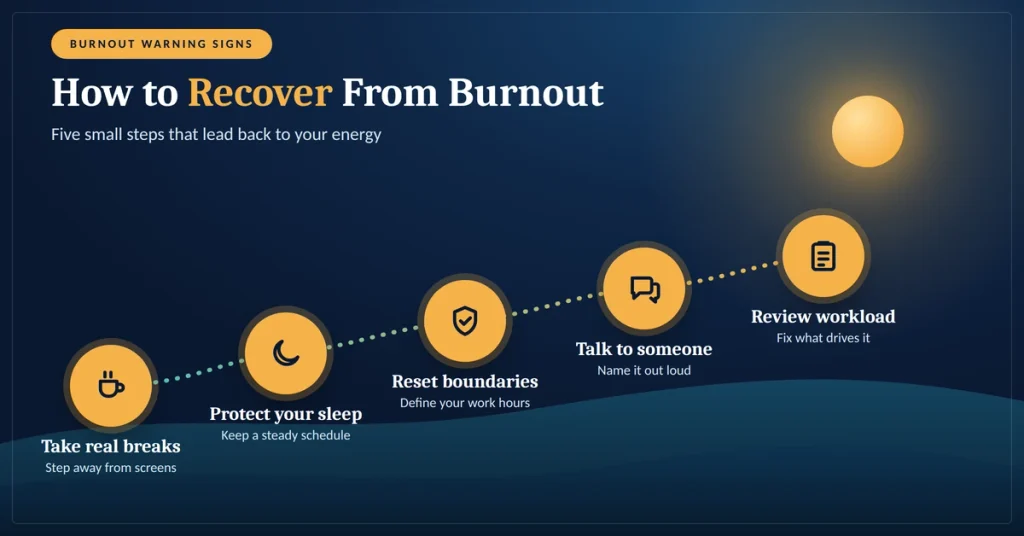
Good news first: recovery is possible. The steps below show what to do when you feel burned out without blowing up your whole life.
Start With Small, Immediate Moves
Tiny changes work best at the beginning. Take real breaks away from screens. Protect your sleep window. Say no to one non-essential commitment this week. Think of it as plugging a leak before you repaint the house.
Reset Your Boundaries
Boundaries keep work from swallowing your life. Define your working hours. Mute notifications after hours. Ask your manager to clarify priorities when everything feels urgent. Better work-life balance isn’t a luxury. It’s maintenance.
Talk to Someone You Trust
Say it out loud to a friend, family member, mentor, or manager. Naming the problem lightens its weight. You’d be surprised how often others say, “Me too.”
Look at the Bigger Picture
Sometimes personal habits aren’t the main issue. Experts say employers and managers share responsibility for spotting and preventing burnout. If your workload, role, or team culture drives the problem, the fix may involve a bigger conversation. That’s where employee burnout warning signs matter to leaders too. Even the buzzword quiet quitting often grows from the same soil: people protecting themselves from overload.
Looking for how to recover from burnout fast? Honestly, speed depends on the cause. Quick wins like better sleep and lighter schedules help within days or weeks. Deeper recovery takes longer. Treat it as a steady climb rather than a sprint.
When to See a Doctor for Burnout
Self-help has limits. Reach out to a professional if:
- Symptoms last for weeks and keep getting worse
- Daily functioning, relationships, or physical health suffer
- Your mood sinks low in all areas of life, not only work
- You notice signs that overlap with anxiety or depression
A doctor, counselor, or psychologist can rule out other causes and build a plan with you. These mental health tips for working professionals apply to students and caregivers too. Here’s the most important point: if you ever have thoughts of harming yourself, contact your local emergency services or a crisis line right away. You deserve immediate support.
This article offers general education. It doesn’t replace personalized medical advice.
Frequently Asked Questions About Burnout Warning Signs
What are the first signs of burnout? The first signs of burnout are usually deep tiredness, rising irritability, and a drop in motivation. You might also notice sleep trouble and a more negative attitude toward work. These early signs of burnout are easy to miss because they build slowly.
How do I know if I’m burned out or just tired? Ask yourself one question: does rest fix it? Tiredness fades after sleep or a break. Burnout lingers. If you also feel detached and ineffective, that points toward burnout. This is the heart of how to know if you’re burned out.
How long does burnout last? There’s no single timeline. Mild cases may ease within weeks once you change your workload. Severe cases can take months. The answer depends on the cause and how much support you get.
Can burnout go away on its own? Rarely. If the same pressures continue, burnout won’t simply vanish. Rest helps temporarily, but lasting relief usually needs real changes to workload, boundaries, or environment.
Is burnout the same as being lazy? No. Lazy people avoid effort without distress. Burned-out people usually care too much for too long. Many of them are your hardest workers.
Can students and stay-at-home parents get burned out? Yes. The WHO’s formal definition focuses on work. Even so, students, parents, and caregivers describe the same exhaustion and detachment. The warning signs of burnout look similar no matter the setting.
Final Thoughts: Don’t Ignore the Burnout Warning Signs
Burnout speaks in three languages: your body, your emotions, and your behavior. Physical clues include constant fatigue and aches. Emotional ones include cynicism and irritability. Behavioral ones include procrastination and withdrawal. Catch them early and you protect your health, your relationships, and your work.
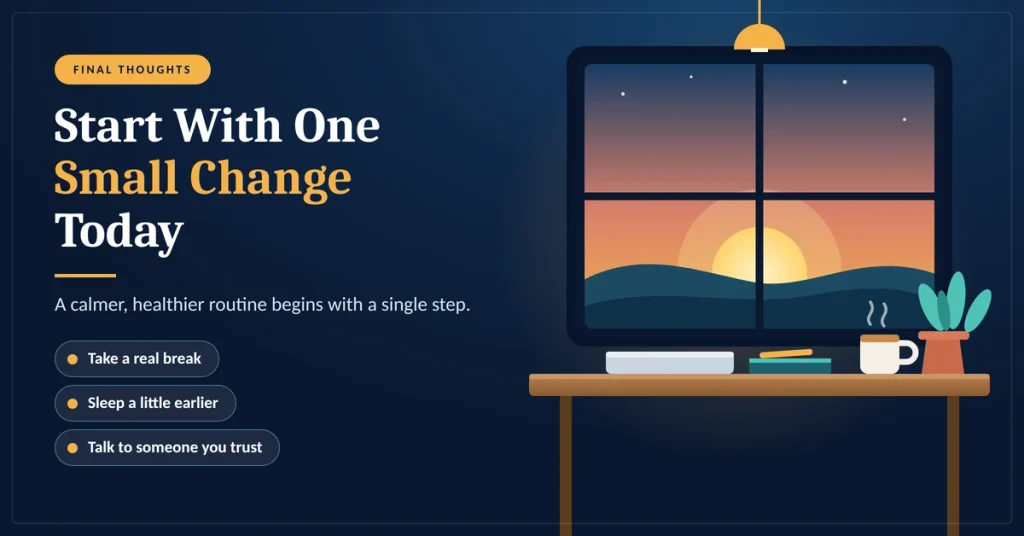
So here’s your challenge for today. Pick one small change. Maybe it’s a real lunch break. Maybe it’s an earlier bedtime or one honest conversation. Start there. Then share this guide with someone who might need it. A single nudge can change a lot.